- February 7, 2026
- Posted by: admin
- Category: BitCoin, Blockchain, Cryptocurrency, Investments
Bitcoin is struggling to stabilize around the $65K level as persistent selling pressure continues to weigh on market sentiment. The recent decline has reinforced uncertainty among investors, with volatility increasing and liquidity conditions tightening across major trading venues. Against this backdrop, on-chain data is beginning to reveal shifts in market structure that may help explain the current weakness.
A CryptoQuant report highlights a notable change in Bitcoin flows on Binance during the first days of February. Data shows that the whale inflow ratio — which measures the share of deposits coming from large wallets — has climbed to its highest level since 2022. This suggests a renewed presence of major holders on the exchange deposit side, a development often associated with repositioning, risk reduction, or preparation for active trading.
According to the report, total Bitcoin inflows to Binance reached roughly 78,500 BTC, while whale inflows alone accounted for about 38,100 BTC. As a result, whales represented approximately 48.5% of all deposits during this period. This means nearly half of the Bitcoin sent to the exchange originated from large addresses, marking a meaningful structural signal that could influence short-term price dynamics and broader market sentiment.
Whale Activity Signals Market Transition, Not Automatic Selling
The report emphasizes that the recent surge in the whale inflow ratio should not automatically be interpreted as imminent selling pressure. Large holders often move funds to exchanges for multiple operational reasons beyond liquidation. In this context, some whales may simply be reallocating capital, adjusting portfolio exposure, or positioning liquidity for derivatives trading rather than preparing immediate spot sales.
Another plausible explanation is defensive positioning. After periods of elevated volatility, institutional or high-net-worth participants frequently transfer assets to exchanges to hedge risk, secure profits, or maintain flexibility in uncertain market conditions. This behavior tends to increase during corrective phases, when sentiment weakens, and liquidity becomes more fragmented.

Historically, spikes in whale inflows have typically appeared during market transition stages rather than at definitive tops or bottoms. In several past cycles, similar readings preceded short-term selling waves as large players reduced exposure. However, there have also been instances where comparable inflow patterns coincided with accumulation phases, reflecting repositioning before renewed upward momentum.
Ultimately, the current data suggests a fragile equilibrium between supply and demand rather than a clear directional signal. Monitoring follow-through — particularly exchange outflows, derivatives positioning, and spot demand — will be essential to determine whether this activity evolves into distribution or longer-term accumulation.
Breakdown Below Trend Support Raises Structural Risk
Bitcoin’s price action in this chart reflects a decisive shift in market structure following a prolonged corrective phase. After failing to sustain momentum above the $110K–$120K region, price gradually transitioned into a lower-high sequence, ultimately accelerating downward with a sharp breakdown below the $70K area. The most recent move toward the mid-$60K range represents the weakest level seen since late 2024, confirming that sellers currently dominate the trend.
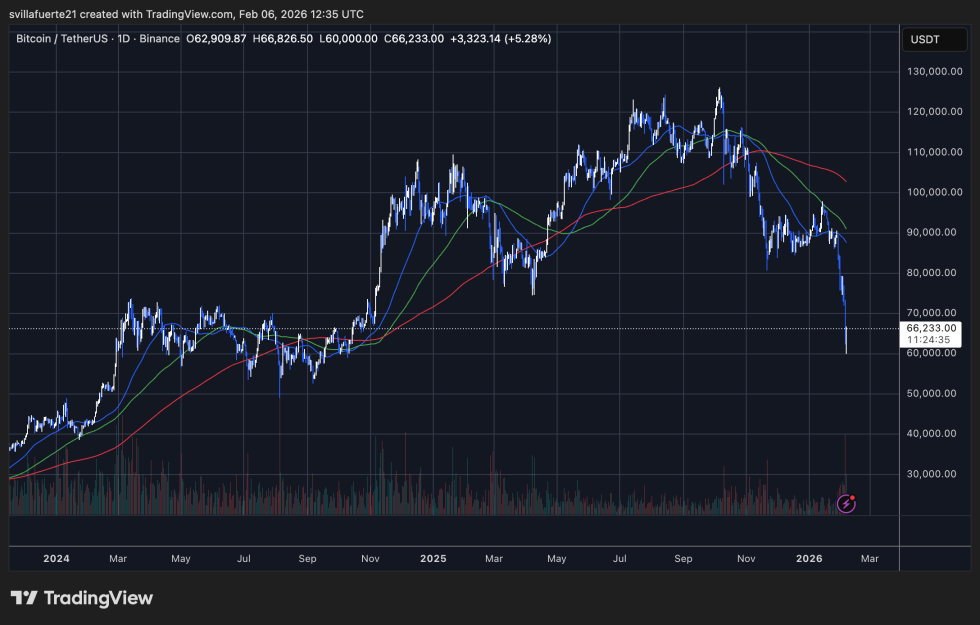
From a technical perspective, price has fallen below key moving averages, including what appears to be the 50-, 100-, and 200-period trend lines. This alignment typically signals a bearish regime rather than a short-term pullback. Additionally, the rejection near the longer-term average before the latest drop suggests that previous support has flipped into resistance, reinforcing downside pressure.
Volume dynamics also indicate stress. The spike accompanying the breakdown implies forced selling or liquidation activity rather than orderly distribution. Historically, such conditions often precede either a volatility climax or a prolonged consolidation phase while the market searches for equilibrium.
For now, the critical question is whether the $60K–$65K region can hold as structural support. Failure there could open a deeper retracement, whereas stabilization may indicate the early stages of a base formation rather than an immediate reversal.
Featured image from ChatGPT, chart from TradingView.com