- September 14, 2026
- Posted by: admin
- Category: BitCoin, Blockchain, Cryptocurrency, Investments

Tuesday’s US estimated-tax deadline will shift cash toward the Treasury, testing whether last week’s improvement in bank reserves can hold through the Federal Reserve’s meeting. Bitcoin liquidity could come under pressure if the transfer tightens dollar funding and limits risk-taking before policymakers conclude their September 15–16 meeting.
The IRS calendar sets September 15, 2026 as the third installment deadline for individuals and corporations subject to estimated-tax payments. It falls on the opening day of the Fed meeting, putting a scheduled cash movement alongside the policy decision due the following day.
Bank reserves are balances commercial banks hold at the Fed. They support payments and funding, rather than measuring traders’ available cash. The starting point is stronger than a week earlier. The Fed’s September 10 balance-sheet release showed weekly-average bank reserves rose $96.779 billion to about $2.991 trillion in the week ended September 9. Over the same period, the Treasury General Account, the government’s account at the Fed, fell $84.6 billion to $883.3 billion on a weekly-average basis.
Those are averages, not Wednesday’s snapshot. The separate September 9 levels were about $3.037 trillion for reserves and $843.705 billion for Treasury cash.
How US tax payments could affect Bitcoin liquidity
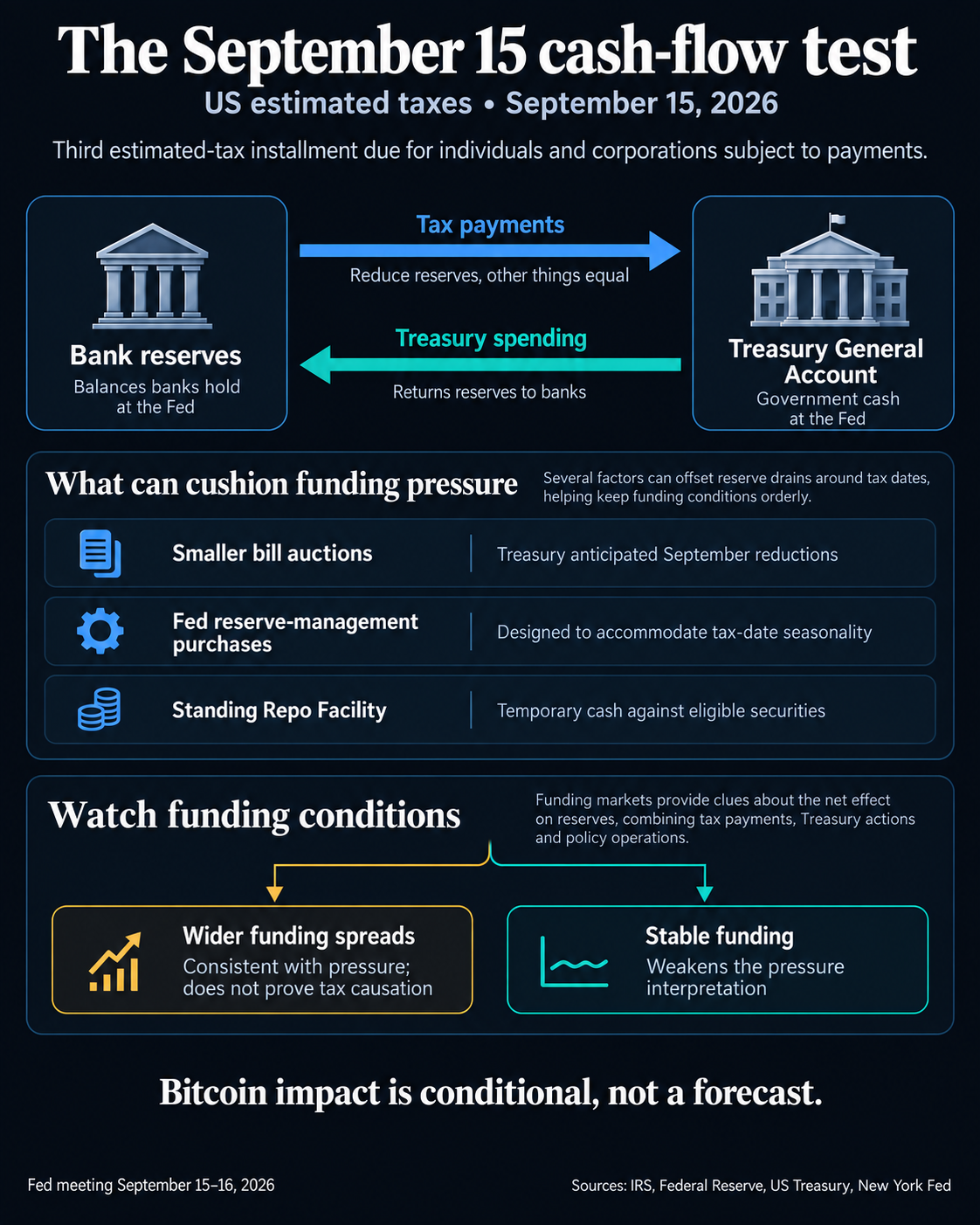
The accounting mechanism is straightforward: tax payments move balances from commercial banks’ reserve accounts into the Treasury’s account. Treasury spending moves funds back to recipient banks. Other things equal, incoming taxes reduce reserves, while outgoing government payments replenish them.
That can matter for short-term financing, including repo markets where cash is borrowed against securities. The New York Fed’s account of September 2019 describes how a temporary reserve decline, Treasury settlements and a corporate tax date combined with a spike in repo rates. It is a historical example of the mechanism, not evidence that this Tuesday will repeat it.
Several forces can cushion the transfer. In its August 5 refunding statement, Treasury anticipated September reductions in shorter-dated bill auction sizes because of mid-month tax receipts. Less bill borrowing could partly offset cash absorption relative to unchanged issuance. The size of that offset depends on actual borrowing and spending.
The Fed also plans for seasonal reserve demand. Its May 2026 balance-sheet report says reserve-management purchases accommodate fluctuations such as tax dates and adjust to the reserve outlook. The New York Fed describes the Standing Repo Facility as a backstop supplying eligible institutions with temporary cash against securities to limit upward funding pressure.
For Bitcoin investors, the possible effect runs through financing conditions and appetite for risk.
BIS research finds that stablecoin market capitalization declines after US monetary tightening. That supports broader sensitivity to monetary conditions, not a measured Bitcoin response to this tax deadline.
The useful signal is therefore whether short-term funding spreads widen relative to Fed-administered rates as taxes settle. Rising spreads would be consistent with funding pressure without proving taxes caused it; stable funding would weaken that interpretation. Tuesday’s calendar creates a test, while spending, bill supply and Fed liquidity tools help determine the result.
The post Another Bitcoin liquidity test arrives with Tuesday’s US tax deadline appeared first on CryptoSlate.