- September 15, 2026
- Posted by: admin
- Category: BitCoin, Blockchain, Cryptocurrency, Investments

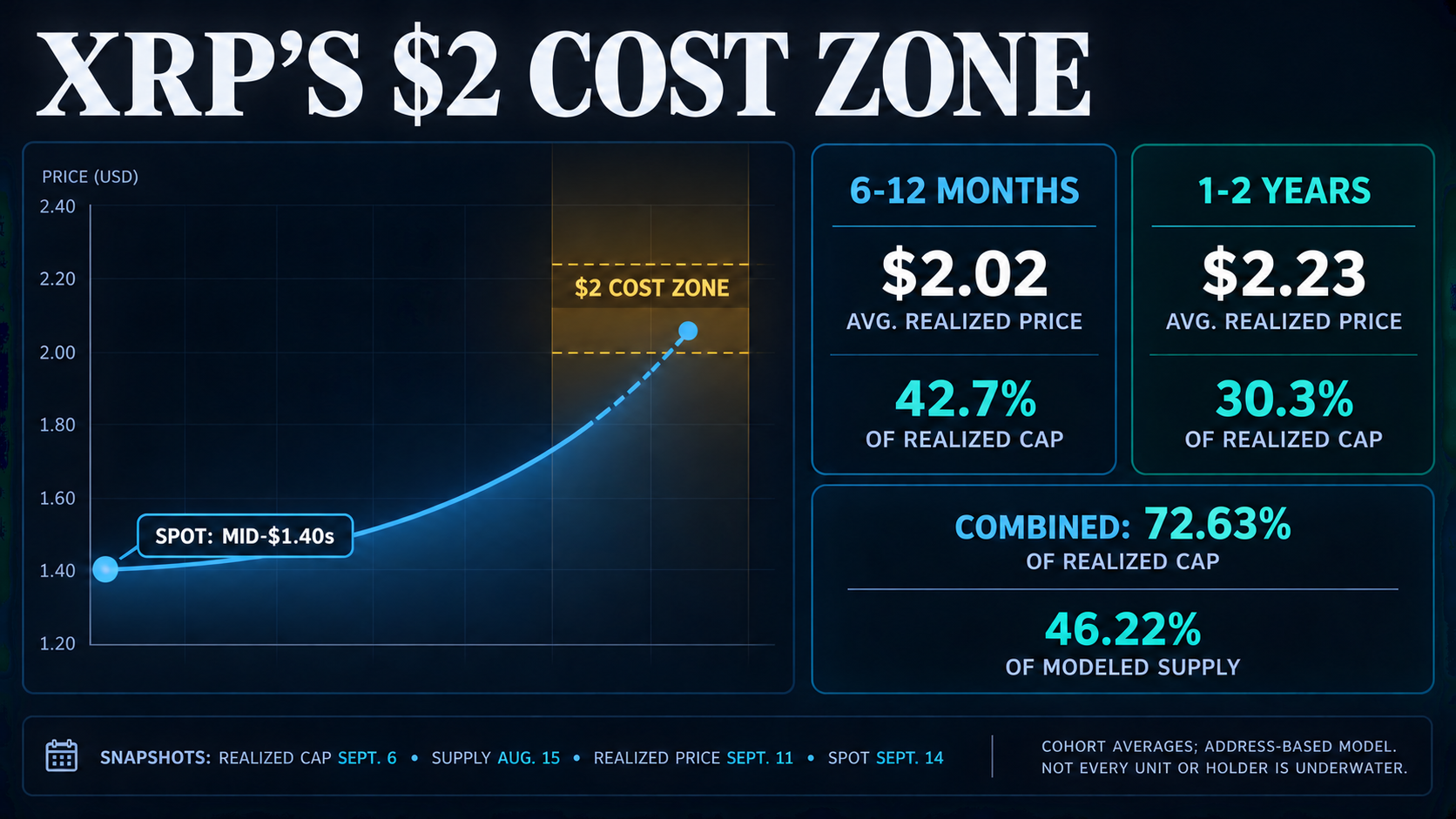
Nearly 75% of XRP’s realized capitalization is concentrated in coins that last moved six months to two years ago. Their average realized prices start above $2, leaving the market’s largest cost-basis cohorts below their modeled entry levels while XRP trades in the mid-$1.40s.
A rally toward $2 would approach the average cost of the cohorts carrying most of XRP’s realized value, giving the market a chance to show whether those coins remain dormant or move more actively as modeled losses shrink.
A concentrated cost zone sits above XRP
Glassnode’s Sept. 6 realized-cap snapshot placed over $39.2 billion in the six-to-12-month XRP cohort and $27.5 billion in the one-to-two-year cohort. Together, the two groups represented 72.6% of the network’s realized capitalization.
Realized capitalization values each unit at the price when it last moved, mapping where the network’s embedded cost basis sits, while market capitalization values every unit at today’s price.
The related supply-by-age snapshot from Aug. 15 put 31.36 billion XRP (46.22% of modeled supply) in the same two bands. Both breakdowns use addresses, which can represent individuals, exchanges, custodians, or other entities. Transfers and custody changes can also reset when coins last moved without marking a purchase.
Almost half of modeled supply belongs to age bands whose average realized prices are above $2, but the data cannot show that every unit or beneficial holder in those bands is underwater.
Glassnode’s Sept. 11 realized-price data put the six-to-12-month cohort at $2.02 and the one-to-two-year cohort at $2.23. Realized price estimates a cohort’s average acquisition cost from the market price when its coins last moved.
Glassnode placed the three-to-six-month cohort near $1.40, the one-to-three-month cohort at $1.14, and the one-week-to-one-month cohort at $1.28. With XRP in the mid-$1.40s on Sept. 15, newer cohorts sat near or above their average costs, while the two groups dominating realized capital averaged below theirs.
Recent buyers have less distance to profitability, while a move toward $2 would bring a much larger stock of historical capital into the modeled breakeven zone.
Heavy rotation meets a policy catalyst
CryptoQuant contributor CryptoOnchain reported that Binance received 91.23 million XRP and sent out 113.91 million XRP on Sept. 11, with both gross flows being six-month highs.
At the same time, Binance’s seven-day average XRP reserve stood at 2.63 billion, 0.43% higher than a week earlier and 0.18% below its quarterly baseline. Average derivatives open interest was $476.7 million, up 0.23% week over week.
Large inflows can precede selling, while large outflows can reflect withdrawals or internal transfers. Both surging on the same day, alongside modest reserve and open-interest changes, supports CryptoOnchain’s characterization of gross rotation.
The contributor listed internal wallet movements and market-maker rebalancing as possible explanations, while leaving both unconfirmed. The analysis also excluded Sept. 12 from several weekly comparisons because that day’s fields were incomplete.
Tuesday’s Senate procedure provides the next outside catalyst. The official schedule says the cloture motion concerning H.R. 3633, the Digital Asset Market Clarity Act, will ripen at 2:15 p.m. ET on Sept. 15.
The action concerns cloture on the motion to proceed, a step toward opening debate rather than final passage. Under the Senate’s ordinary cloture rule, legislation generally needs three-fifths of senators duly chosen and sworn, or 60 votes in a full Senate.
Republican sponsors said the final draft reflected 126 substantive changes requested by Democrats. A Sept. 10 release from Sen. Cynthia Lummis had described the earlier text as incorporating more than 114 provisions, indicating that negotiations continued before the procedural test.
For XRP, the vote’s relevance extends beyond the token’s regulatory label. A March SEC securities-law interpretation, accompanied by CFTC guidance, already named XRP as an example of a digital commodity. The interpretation created no new legal obligations and did not enact the statutory market structure CLARITY contemplated.
A positive response to progress in Congress could reflect expectations for the broader US framework around digital-commodity trading and intermediaries.
A move toward $2 would become more meaningful if older coins moved more actively, Binance net flows and reserves turned decisively higher, or open interest expanded alongside spot demand. Continued high gross flows with stable inventory would instead reinforce the rotation reading.
XRP currently sits beneath a concentrated cost zone while large volumes move through Binance without a firm directional signal. The next rally can reveal whether the six-month-to-two-year cohorts stay dormant or become more active as their average losses narrow.
The post XRP’s path back to $2 now hinges on whether the Senate passes the CLARITY Act appeared first on CryptoSlate.