- January 9, 2026
- Posted by: admin
- Category: BitCoin, Blockchain, Cryptocurrency, Investments
Bitcoin is struggling to maintain strength above the $90,000 level after once again failing to break through the critical $94,000 resistance zone. What initially appeared to be a recovery attempt has gradually lost momentum, leaving BTC trapped in a broad consolidation range that has persisted since late November. Each push higher has been met with selling pressure, reinforcing the idea that bulls are losing control of the short-term trend.
Market sentiment remains fragile. Volatility has compressed, directional conviction is weak, and price action increasingly reflects indecision rather than accumulation. While long-term holders appear largely inactive, the absence of aggressive dip buying suggests that confidence across the broader market is still muted. This environment has created fertile ground for sharp reactions, but not yet for a sustainable trend reversal.
Crucially, on-chain data shows that retail investors are still missing in action. Measures tracking retail demand indicate continued weakness, highlighting that the recent stabilization in price has not been driven by renewed participation from smaller investors.
Historically, strong Bitcoin advances tend to coincide with rising retail involvement, as fresh demand reinforces upside momentum. Without that cohort returning, current price support looks increasingly vulnerable.
Retail Demand Remains Absent
According to data shared by Maartunn, Bitcoin’s 30-day change in Retail Investor Demand remains deeply negative, underscoring a critical weakness beneath the surface of current price action. In simple terms, the crowd has not returned to the market—at least not in a meaningful way.

Retail investors historically play a crucial role in sustaining bullish trends. They provide incremental demand, amplify momentum, and often arrive after periods of consolidation or early recoveries. When retail demand is expanding, price advances tend to be more durable. The opposite is also true. A persistently negative 30-day retail demand metric signals that smaller investors are either staying on the sidelines or continuing to reduce exposure.
This helps explain why Bitcoin’s recent attempts to reclaim higher levels have struggled. Without fresh retail inflows, upside moves rely almost entirely on larger players absorbing supply. That dynamic can support temporary bounces, but it often lacks the depth required for a sustained breakout.
From a risk perspective, weak retail participation also increases fragility. If price rallies into resistance without new demand entering the system, it becomes more vulnerable to pullbacks triggered by profit-taking or external shocks.
Until retail demand begins to recover and shift into positive territory, Bitcoin’s price action is likely to remain range-bound, with rallies facing structural headwinds rather than broad-based support.
Bitcoin Consolidates Below Key Resistance
Bitcoin’s lower-timeframe structure highlights a market that remains fragile despite recent recovery attempts. On the 4-hour chart, BTC is trading just below the $90,000 level after failing to sustain momentum above the $94,000–$95,000 zone earlier this month. That rejection marked a clear lower high, reinforcing the broader corrective structure that has been in place since late November.
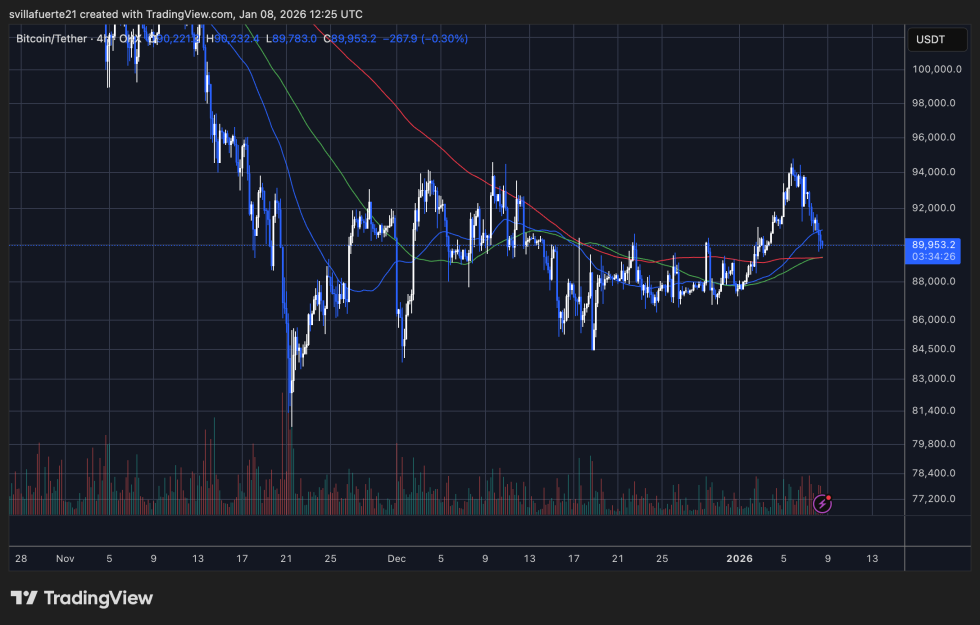
From a trend perspective, price is oscillating around its short- and medium-term moving averages, with the 50-period and 100-period averages acting as dynamic resistance rather than support. Each push higher has been met with selling pressure, suggesting that upside liquidity is still being used as an exit rather than as confirmation of renewed demand. The 200-period moving average on this timeframe remains overhead, capping rallies and defining the upper boundary of the current range.
Structurally, Bitcoin is consolidating between roughly $87,000 and $92,000. This range reflects indecision rather than strength. While buyers have defended the lower boundary multiple times, the lack of follow-through above resistance signals exhaustion. Volume has also compressed compared to the November sell-off, indicating reduced participation and a lack of conviction on both sides.
Unless BTC can reclaim the $92,000–$94,000 region with strong volume and hold it as support, the current move remains a corrective bounce. A breakdown below the $87,000 support would likely reopen downside risk toward deeper liquidity levels, keeping short-term risk elevated.