- February 27, 2026
- Posted by: admin
- Category: BitCoin, Blockchain, Cryptocurrency, Investments
Bitcoin has regained short-term momentum after a roughly 7% surge on Wednesday, providing some relief to a market that had remained under persistent selling pressure. The rebound followed renewed discussion around Jane Street — the global quantitative trading firm that was widely accused in parts of the crypto community of contributing to the 2022 LUNA collapse, although no formal proof ever confirmed direct responsibility. The resurfacing of that narrative appears to have coincided with improved liquidity expectations and short-term repositioning, helping stabilize sentiment after recent volatility.
Despite the rebound, structural stress remains visible beneath the surface. According to top analyst Darkfost, the On-Chain Trader cohort — defined as holders with coins aged between one and three months — has a realized price near $90,000. With Bitcoin currently trading around $68,000, this group is sitting on an average unrealized loss of approximately 24%, a level that historically increases behavioral sensitivity.
Deviation bands around this realized price further contextualize the pressure zone. The upper bands sit near $126,000 and $153,000, while downside thresholds are positioned around $79,000 and $56,000. These levels help frame potential mean-reversion paths, underscoring that although momentum has improved, a large segment of recent buyers remains underwater.
Bitcoin Realized Price Bands Highlight A Critical Inflection Zone
Bitcoin is currently navigating a sensitive phase that could determine whether the recent rebound evolves into a sustainable recovery or merely a temporary relief within a broader corrective structure. Price remains well below the realized price of the 1–3 month on-chain trader cohort, estimated near $90,000, leaving a substantial portion of recent entrants in unrealized loss territory. This positioning typically increases market reactivity, as short-term holders tend to respond quickly to price fluctuations.

Darkfost’s framework around deviation bands provides useful context for assessing potential pressure zones. These statistical ranges help identify where latent profits or losses accumulate. Historically, when Bitcoin has approached the upper “Max” deviation band during this cycle, corrective phases often followed, suggesting that overheated positioning tends to invite distribution or profit-taking.
At present, however, the situation is inverted: traders are largely underwater rather than in profit. That reduces immediate profit-taking risk but increases sensitivity to further downside. Importantly, price still needs a meaningful recovery before this cohort returns to a comfortable average profit position.
Consequently, Bitcoin sits at a technical and behavioral inflection point. Continued stabilization could gradually rebuild confidence, but renewed weakness risks reinforcing defensive positioning and extending the corrective phase.
Bitcoin Holds $65K After Sharp Structural Breakdown
Bitcoin remains under technical pressure despite a recent rebound, with price action currently stabilizing near the $68K region after a steep decline from late-2025 highs. The chart shows a clear structural breakdown below the $90K–$95K zone, which previously acted as strong support. That level now appears to function as resistance, suggesting a transition from bullish expansion toward a corrective phase.
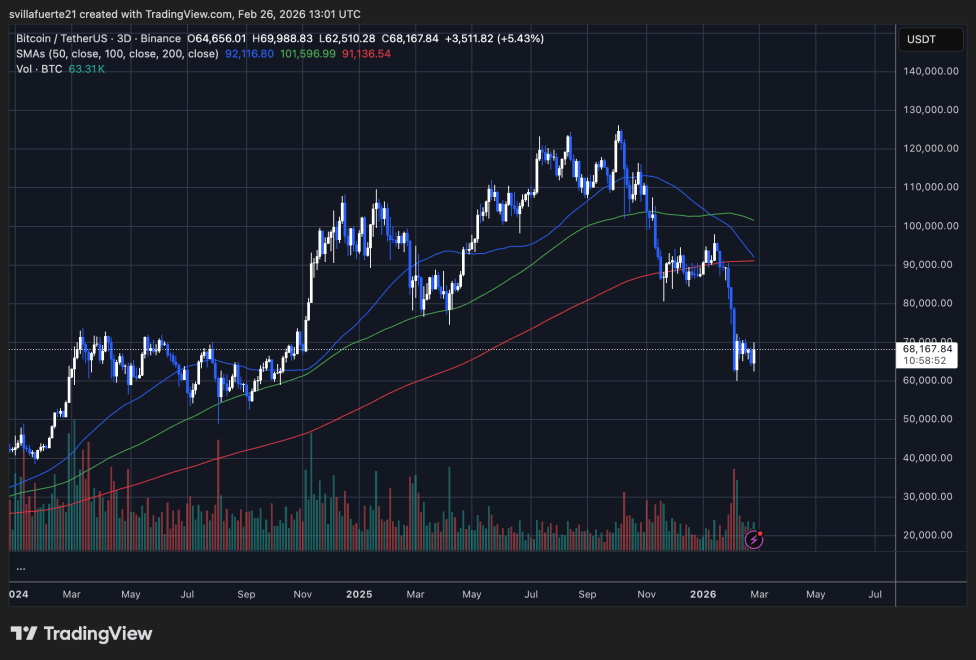
The moving averages reinforce this interpretation. BTC is trading below the 50-period and 100-period averages, both of which are beginning to slope downward. This configuration typically reflects weakening momentum and reduced trend strength. The 200-period average remains lower and still upward sloping, indicating that the longer-term trend has not fully reversed but is under stress.
Volume dynamics add another layer. The most recent selloff occurred alongside elevated volume spikes, pointing to forced positioning adjustments rather than gradual distribution. Since then, recovery attempts have lacked comparable participation, which raises questions about the durability of the bounce.
From a structural standpoint, holding above the mid-$60K zone is critical. Losing that area could expose lower liquidity pockets and intensify downside volatility. Conversely, sustained consolidation here could allow the market to rebuild demand, particularly if broader liquidity conditions begin to improve.
Featured image from ChatGPT, chart from TradingView.com