- September 16, 2026
- Posted by: admin
- Category: BitCoin, Blockchain, Cryptocurrency, Investments

XRP fell more than 8% after the Senate blocked a key crypto bill, even as the token’s existing US regulatory treatment remained intact.
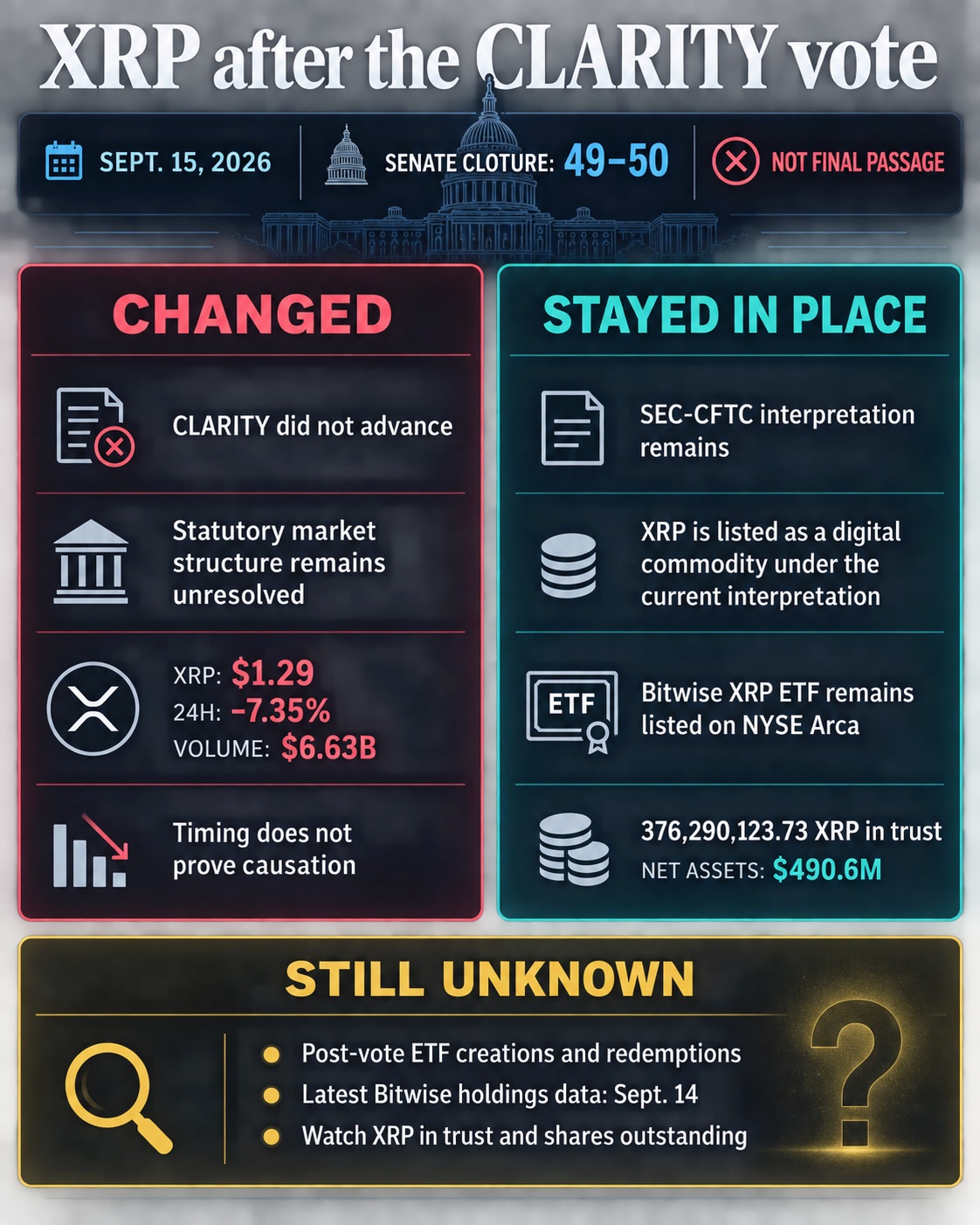
CryptoSlate data showed XRP falling as low as $1.27 before recovering to about $1.29 as of press time, extending a decline from roughly $1.42 on Sept. 14. The selloff coincided with broader weakness across major cryptocurrencies and a wave of leveraged long liquidations.
The price action followed US lawmakers’ rejection of an effort to advance the Digital Asset Market Clarity Act. The 49-50 vote failed to invoke cloture on a motion to proceed to H.R. 3633, denying one of the crypto industry’s biggest legislative priorities enough support to reach Senate debate and removing a near-term route toward putting a federal market-structure framework into statute.
Ripple Chief Executive Brad Garlinghouse said the result “stings,” but argued that it does not alter the company’s commercial trajectory. He pointed to demand across traditional finance and the digital-asset industry, saying the failed vote does not change Ripple’s momentum, global footprint or customer base.
Ripple turns to regulators as Congress stalls
Ripple’s confidence rests partly on the regulatory ground XRP gained before the CLARITY vote, which Chief Legal Officer Stuart Alderoty argues remains intact despite the Senate setback.
Alderoty pointed to the March action by the Securities and Exchange Commission (SEC) and Commodity Futures Trading Commission (CFTC), saying XRP continues to stand on “settled ground.”
The SEC issued a Commission-level interpretation outlining how federal securities laws apply to several categories of crypto assets, while the CFTC said it would administer the Commodity Exchange Act consistently with that framework. XRP was among 18 assets identified as digital commodities based on their characteristics, terms and functions at the time.
That treatment remains in effect even after the failed Senate vote, preserving regulatory clarity XRP lacked during much of Ripple’s years-long legal battle with the SEC.
Ripple said the development gives the company an advantage as much of the broader digital-asset industry continues operating without a comprehensive statutory market structure.
The protection is less durable than legislation, however. The March action interprets laws already on the books and leaves the SEC room to refine or revise its approach.
It also preserves transaction-specific analysis under the Howey test, meaning a digital commodity that is not itself a security can still be offered or sold as part of an investment contract subject to securities laws.
That distinction puts greater weight on what regulators do next. With Congress stalled, Ripple expects SEC Chairman Paul Atkins and CFTC Chairman Mike Selig to take a larger role in developing crypto rules and said it will remain engaged with both agencies as that process moves forward.
The company also said it expects XRP’s digital-commodity treatment to remain intact through future rulemaking.
The agencies can clarify how existing statutes apply to trading, custody and other crypto activities, but a broader division of authority between the SEC and CFTC would still require congressional action.
That leaves the industry dependent on a combination of court decisions, agency interpretations and future rulemaking while lawmakers determine whether another market-structure proposal can attract the votes CLARITY could not.
Ripple, meanwhile, is signaling that the legislative setback will not slow its commercial expansion. The company said demand remains strong across payments, stablecoins and institutional markets and that it plans to continue expanding its global business while pressing for clearer U.S. rules.
Institutional demand for XRP-linked products also remains substantial despite the token’s selloff. US spot XRP exchange-traded funds had attracted about $1.71 billion in cumulative net inflows through Sept. 14, with roughly $1.58 billion in net assets.
That placed XRP behind only Bitcoin and ETH among major US single-asset spot crypto ETF categories tracked in the same data set, and ahead of Solana’s roughly $1.37 billion in cumulative inflows.
The next test is whether that demand persists after the Senate setback and whether the financial agencies can turn their March interpretation into a more durable regulatory framework.
The post XRP falls hard after CLARITY vote as Ripple’s regulatory advantage faces a new test appeared first on CryptoSlate.